Showing posts with label Art. Show all posts

Sunday, September 6, 2026

Complete Guide To Crafted and Prompted AI Film Production


My short film, "Ngozika and the Magic Water Pot" was crafted and not prompted.

Crafting and prompting AI films involves combining structured text generation (like Claude or GPT) with specialized video-generation tools (like Seedance, Luma, or Higgsfield) to maintain character and scene consistency.

Core AI Filmmaking Workflow

Concept and Scripting: Write your baseline logline or narrative idea, then use an assistant like Claude to break the concept down into a structured script, scene list, or shot-by-shot prompts.
Visual Anchors and Character Sheets: Generate reference images or character turnaround sheets first using tools like Nano Banana Pro or Ltx Studio to lock in faces, wardrobe, and distinct visual styles before animating.


Prompt Engineering by Category: 

Structure prompts with explicit cinematic terminology—specifying camera lenses (e.g., 35mm T1.4), specific lighting setups, framing angles, and precise motion rather than vague descriptions.
Generation and Iteration: Feed reference character IDs and storyboard frames into video models (such as Higgsfield or Luma Dream Machine) to generate short clips, using start and end frames to control pacing.

Editing and Audio: Export your clips into a traditional non-linear editor like Da Vinci Resolve, and layer in voiceovers, background tracks, and sound effects using platforms like ElevenLabs.

Crafted AI films rely on a structured pre-production workflow, whereas prompted AI films rely on direct text generation.

Prompted AI Films
Direct generation: You type a text command into an AI video generator and let the model create the scene instantly.

Speed: Fast and useful for quick tests, concepts, or abstract clips.
Drawbacks: Often results in inconsistent characters, shifting backgrounds, and a disconnected narrative feel.


Crafted AI Films
Structured workflow: You plan the story, script, and visual style before generating any video.
Asset control: You create specific character sheets and location references to keep appearances uniform across every shot.

Post-production: You edit clips together in software like Da Vinci Resolve or CapCut to fix errors and add synchronized sound.
To make a full story-driven AI movie, you must use the crafted approach. Direct prompting alone will cause your characters, lighting, and backgrounds to change completely from shot to shot.
Building a coherent feature or short film requires a structured, multi-step production pipeline.

1. Scripting & Visual Planning

Write a tight script: Use tools like ChatGPT or Claude to format a standard screenplay.
Generate a storyboard: Create consecutive image references for every single scene.
Build image-to-video assets: Always use an image as your video starting point, rather than just text, to maintain control over composition.

2. Consistency Framework (The "Crafted" Core)

Character seeds: Generate a master portrait of your character from multiple angles using image generators like Midjourney.
Consistent reference (Cref): Use character reference parameters to lock in facial features across different scenes.
Style sheets: Save specific prompt modifiers (e.g., "35mm anamorphic lens, moody cyberpunk lighting, muted color palette") to apply to every background image.

3. Video Generation & Movement

Animate the stills: Feed your consistent master images into video engines like Runway Gen-3, Luma Dream Machine, or Sora.
Keep camera motion subtle: Large camera movements cause AI video to warp and distort. Stick to pans, tilts, and slow zooms.
Upscale key shots: Use video enhancers like Topaz Labs Video AI to clean up low-resolution artifacts before editing.

4. Audio & Post-Production

Voice cloning: Use ElevenLabs to generate consistent, emotionally expressive character dialogue.
Sound design: Layer background ambiances, foley (footsteps, clothing rustle), and cinematic music tracks in an editor.
Traditional editing: Piece your clips together in DaVinci Resolve or Adobe Premiere. Use color grading to blend different AI generations into a unified visual look.

Step-by-Step Production Roadmap
Here is a complete project blueprint to guide you from concept to final render. You can download this checklist to track your progress:
Here is your file: ai_movie_production_roadmap.md.

Phase 1: Pre-Production: Scripting, character design, and style guiding.
Phase 2: Asset Generation: Generating consistent images and animating them into video clips.
Phase 3: Audio & Editing: Dialogue creation, sound layering, pacing, and color grading.
(Note: The blueprint has been successfully.

To create a historical epic with AI, you biggest challenge is historical accuracy and scale. AI video models easily mix up eras, clothing styles, and architecture. You must use precise visual terminology to force the AI to maintain a grounded, big-budget cinematic look.

Here is your production kit for a historical epic.

1. Visual Style & Cinematic Prompts

Lenses selection

Use terms like "Panavision anamorphic lenses" or "70mm IMAX format" to get wide, sweeping epic framing.
Lighting style: Use "Chiaroscuro lighting", "natural golden hour sunlight", or "flickering torchlight" to mimic period films like Gladiator or The King.
Color grading: Specify color palettes such as "muted earth tones, deep crimson accents, and desaturated blues" to avoid a cheap, oversaturated digital look.

2. Crafting Massive Scale (Battles & Cities)

Crowd generation: Avoid asking for "thousands of soldiers marching." AI will warp the faces and bodies. Instead, prompt for a "low-angle wide shot of an army encampment, hundreds of tents, smoke rising, silhouettes".
Environmental plates: Establish your setting first. Prompt for "wide aerial drone shot of ancient Roman marble colosseum, pristine condition, 1st century AD, dusty atmosphere".
The "Fog of War" trick: Add "heavy atmospheric haze, dust particles floating, dense smoke" to your prompts. This hides AI background glitches and enhances the epic mood.

3. Maintaining Historical Accuracy

Specify materials: Do not just say "armor" or "dress." Say "weathered iron lorica segmentata armor with leather straps" or "coarse linen tunic with gold embroidery".
Architectural cues: Detail the textures. Use terms like "eroded limestone pillars", "rough-hewn wooden palisades", or "cracked cobblestone streets".
Avoid modern buzzwords: Never use words like "photorealistic" or "hyperrealistic." Use historical references instead: "historical oil painting texture, gritty realism, 35mm film grain".

4. Audio Architecture

Orchestral weight: Use AI music tools like Udio or Suno to generate a "slow, swelling orchestral brass theme with heavy taiko drums and driving cellos".
Soundscapes: Layer continuous background audio. You will need tracks of "distant clashing iron, horse whinnies, heavy wind gusts, and crackling campfires" to sell the environment.
Historical Epic Prompt Templates
Copy and paste these master formulas into your image generator (like Midjourney or Flux) before animating them:

text
[Character Close-Up]
Cinematic medium close-up of a battle-weary 14th-century knight, mud splattered on face, deeply detailed eyes reflecting campfire light, dented steel chainmail armor. Shot on 70mm lens, film grain, historical realism, dark moody atmosphere --ar 16:9
Use code with caution.

text
[The Wide Establishing Shot]
An Establishing wide shot of an ancient mountain fortress at sunrise, stone towers cutting through thick low-hanging fog, torchlight flickering on the ramparts. Epic scale, cinematic lighting, 8k resolution, historical drama aesthetic --ar 16:9
Use code with caution.

Video clip from the making of "Ngozika and Magic Water Pot" with screenshots from the production and pictures for my epic film project on Virgil's classic drama, "The Aeneid" produced with Google Gemini on August, 2026.
© EKENYERENGOZI Michael Chima. All rights reserved. No copying, duplication and reproduction in any format of media without the authorization and permission of the author and publisher.

Tuesday, August 18, 2026

Leonardo da Vinci Was Not Methuselah When He Painted Mona Lisa

Leonardo da Vinci Was Not Methuselah When He Painted Mona Lisa


Many images and now AI videos of the greatest artist of all time, Leonardo da Vinci when he painted the Mona Lisa showed a grand old man with flowing long gray hair and long white beard.
This is totally historically wrong depiction of him, because Leonardo da Vinci was 51 years old when he began painting the portrait of Lisa del Giocondo in 1503. And he continued working on it off and on for many years—and kept it with him until he died—he was 67 years old when he finished or stopped working on the portrait in 1519.


Timeline of the Painting
Born: April 15, 1452
Started (1503): Age 51
Initial period (c. 1503–1506/1507): Ages 51 to 55
Final refinement/Death (1519): Age 67

Mona Lisa, Lisa del Giocondo, born Lisa Camilla di Antonmaria (June 15, 1479 – July 14, 1542) was an Italian noblewoman and member of the Gherardini family of Florence and Tuscany. Her name was given to the Mona Lisa, her portrait commissioned by her husband and painted by Leonardo da Vinci in the Italian Renaissance.

The Mona Lisa is the best known, the most visited, the most written about, the most sung about abd the most parodied work of art in the world.

Images:
1. Mona Lisa.

2. This portrait of Leonardo da Vinci attributed to Francesco Melzi, c. 1515–1518, is the only certain contemporary depiction of Leonardo.

3. Montage of the details of Leonardo da Vinci painting the Mona Lisa at 51 and image of him at 67 making the portrait with  Lisa del Giocondo sitting nearby 
by my description to ChatGPT.
My own images cannot be copied, duplicated or reproduced without my authorization and permission. All rights reserved.

#art
#leonardodavinci
#vinci
#monalisa
#portrait
#painting
#florence

Tuesday, February 3, 2026

About EKENYERENGOZI Michael Chima


Ekenyerengozi Michael Chima (also known by the pseudonym Orikinla Osinachi) is a prominent Nigerian writer, publisher, and multimedia producer born on January 30, 1963, in Lagos Island. 

Professional Roles & Media Presence
He is the Founder and CEO of the International Digital Post Network Limited, the first Nigerian company to attract the IMAX Corporation to Nigeria, King of Kings Books International and Screen Outdoor Open Air Cinema (SOOAC). He secured International partnership with the Cinewav of Singapore for the "One Village, One Cinema" initiative and partnership with the 
International Chamber of Media & Entertainment Industry (ICMEI) of India for the Bollywood To Nollywood Filmmaking workshops for international co-productions between India and Nigeria.

Writer & Publisher
He is the Publisher/Editor of several online platforms, including Nigerians Report Online, Nigerian Times, and the Founder and Publisher/Editor of the popular NOLLYWOOD MIRROR® Series on Nollywood and the Nigerian film industry.

Consultant
He has served as a social media consultant and previously worked as a National Program Consultant for UNICEF Nigeria and independent Production Manager of "Money Wise" business magazine programme on DBN TV.

Advocacy
He is recognized for his advocacy for girl-child education supporting the compulsory education of the millions of underprivileged girls out of school in Nigeria.

Art, Literary & Creative Works
Chima is a notable artist with local and International exhibitions of his drawings and paintings. He  was the national curator for the 1993 World AIDS Day "Art Against AIDS" exhibitions at the National Museum and National Theatre in Nigeria.
He is a prolific writer who is the author of numerous books spanning fiction, poetry, and historical commentary: 
Books
He published his first book, Children of Heaven, in 1987.
His notable titles include Bye, Bye Mugabe, a collection of short stories; collections of his poems in Children of Heaven, The Prophet Lied and Scarlet Tears of London;  The Victory of Muhammadu Buhari and the Nigerian Dream on the 2015 presidential election in Nigeria, In the House of Dogs and Diary of the Memory Keeper.

Prizes
Chima won the first prize in the national essay competition on What I Like Best in Nigeria organized by the Pop magazine in 1976.
His poem "Song of Patriotism" won the first prize in a national poetry competition on the Nigerian Television Authority (NTA) in 1987.
His poem, "Empty Shells in Our Oil  Wells" was one of the finalists for the 2000 Music Society of Nigeria national poetry award.
His short story, "One Day at Obalende Bus Stop" won the third prize in the 2002 Lire en fête short story competition organized by the French Cultural Centre in Nigeria.

Early Success
He directed his first play at age 17 and at 18 he became the youngest independent professional scriptwriter for TV in Africa, writing episodes for the puppet drama series of the Nigerian Television Authority (NTA), the largest TV network on the continent from 1981-84. See 
Nigeria: 'I Started Writing Professionally At 18' - allAfrica.com
https://allafrica.com/stories/201212030437.html

Visual Media
In 2016, he produced the photo album LAGOS in MOTION, documenting Africa's largest megacity from the principal photography of his first long documentary film project, "Lagos in Motion: Sights and Sounds of Africa's Largest Megacity".

Education & Affiliations
Education: He attended St. Gregory's College, Lagos, and later had further education from seminars and workshops by the Nigerian Television Authority (NTA) in 1980, Book Development Council of Nigeria in 1982, Johns Hopkins University's Population Communication Services (JHU/PCS) in 1984 and 1990,  PATH in 1985, UNICEF in Nigeria in 1988, World Health Organization (WHO) in 1993 and other organizations.

Memberships
He has been a member of the Association of Nigerian Authors (ANA) since 1987, the Chautauqua Literary and Scientific Circle (CLSC), Digital Cinema Society (DCS), International Law Office (ILO) and Online News Association (ONA). He participated in the Digital Media Law Project (DMLP), a major initiative based at Harvard University's Berkman Klein Center for Internet & Society. Originally founded in 2007 as the "Citizen Media Law Project," it provided legal resources and education for independent journalists and online media

Chima’s work often bridges the gap between sociocultural analysis and political documentation.

Focus on Nollywood
As a major stakeholder in the Nigerian film industry, Chima has documented its evolution through the NOLLYWOOD MIRROR® Series: This is a comprehensive book series—available in print and digital formats—designed to capture the "big picture" of the industry for a global audience.
The First Edition celebrates Nollywood's icons, its emergence as an African phenomenon, and its strategy for breaking into global markets.
The Second Edition highlights "New Nollywood" developments (circa 2014), including the epic Invasion 1897, the evolution of digital filmmaking, and the first Hollywood star from Nigeria, Orlando Martins.

Film Festivals
He is the Founder and Festival Director of the annual Eko International Film Festival and Zenith International Film Festival.

Political Commentaries
His political writings focus on pivotal moments in Nigeria's democratic history:
The Victory of Muhammadu Buhari and the Nigerian Dream: This book serves as a personal testimony and historical chronicle of the 2015 presidential election. It analyzes the principal actors behind the first time an incumbent president was defeated in Nigeria’s history.

Digital & Periodical Analysis: Through his platforms Nigerians Report Online and Nigerian Times, he provides ongoing commentary on Nigerian federalism, social justice, and leadership.

Satirical Critique: 
Works like Bye, Bye Mugabe use short stories to offer a broader critique of African leadership and political dynamics beyond just Nigeria. 

Contact:

Ekenyerengozi Michael Chima,

The Founder/ CEO,

International Digital Post Network Limited,

Screen Outdoor Open Air Cinema (SOOAC)

https://www.amazon.com/author/ekenyerengozimichaelchima

https://www.linkedin.com/in/michaelchimaeyerengozi

New Nigeria

www.pinterest.com/nigeriansreport


Sunday, January 18, 2026

Art is A Figure of Speech of the Heart, Soul and Spirit

A Bottle of Roses 1


These are my first series of life photography in the new year 2026.

The available on art canvas for the interior decoration of the office or residence.

I have the videos of my A Bottle of Roses, including the background noises of those within the surroundings.

- By Ekenyerengozi Michael Chima,

© All rights reserved.


Friday, March 28, 2025

Nsibidi is Older than the English Language


Nsibidi is Older than the English Language


Nsibidi existed from the 3rd century before the metamorphosis of the English language from the West Germanic languages in the 5th century.


Nsibidi used on an Efik tray made in the 19th century. A mermaid encircled with diagrams including Nsibidi ideogram.

Nsibidi has been described as a Semasiographic script comprised of ideograms and pictograms that were used in southeastern Nigeria among the Ejagham (Ekoid people), Efik, Igbo, and Ibibio societies.
The Ejagham originally came from Northeast Africa which supports my analogy of the origins of Igbo Ukwu art of the ancient Igbo Ukwu Kingdom with the ancient Indus Valley Civilization of the 2600 BCE to 1900 BCE.
Igbos believe that they are descendants of one of the Sons of God who descended from heaven and had a relationship with one of the daughters of Eve. 
(Genesis 6, Holy Bible)

Lucy (Australopithecus) the oldest
fossilized bone comprising 40 percent of the skeleton of a female of the hominin species Australopithecus afarensis was discovered in 1974 in Ethiopia, at Hadar, a site in the Awash Valley of the Afar Triangle, by Donald Johanson, a paleoanthropologist of the Cleveland Museum of Natural History.

Insibidi is the secret language of the Ekpe Leopard Secret Society of the Efik, Ibibio and Igbo societies.
Nsibidi means The Beginning in my mother tongue of the Igbos  sharing borders and ethnic similarities with the Efik and Ibibio tribes.

Nsibidi is more than a written language.
It is also a sign language of the Ekpe Leopard Secret Society and unknown to the various Nigerian artists who have been doing nothing more than to copy and paste Insibidi for drawings, paintings, sculptures, prints and potteries and posing and posturing as experts, Nsibidi is also expressed choreographically in a movement of hands and footsteps of secret language communication by members of the Ekpe Leopard Secret Society and used by the dreaded Ekpe masquerades.


I once confronted an Ekpe masquerade decades ago in the early 1990s on the popular Fola Agoro Road leading to the University of Lagos on my way to visit a beautiful girlfriend, Naomi, the Joy of my heart.
As others were either avoiding or running away from the scary looking Ekpe masquerade holding a machete and bell and a chain was tied to the waist held by his guides, I stood face-to-face with him. He was growling and snorting angrily. I was not afraid, because I have also met original Ekpe masquerades during festivities in my mother's hometown of Umuda Nsigwu in the Umuahia North Local Government area of Abia State of southern eastern Nigeria.
Two weeks ago, whilst waiting for a tailor in front of his residence in the Ekpri Nsukarra village in Uyo, a friendly discussion with one of his young neighbours drifted off to Nsibidi and the Ekpe masquerades and he demonstrated one of the movements of their secret language. 

- Ekenyerengozi Michael Chima

#God
#chima
#nsibidi
#ekoid
#english
#german
#igbo
#efik
#ibibio
#ejagham
#uyo
#abia
#umuahia
#ekpe
#masquerade
#leopard
#secret
#society
#igboukwu
#indusvalley
#africa
#ethiopia
#lucy
#eve
#genesis
#bible
#art
#history

Wednesday, January 8, 2025

Epitome of Beauty


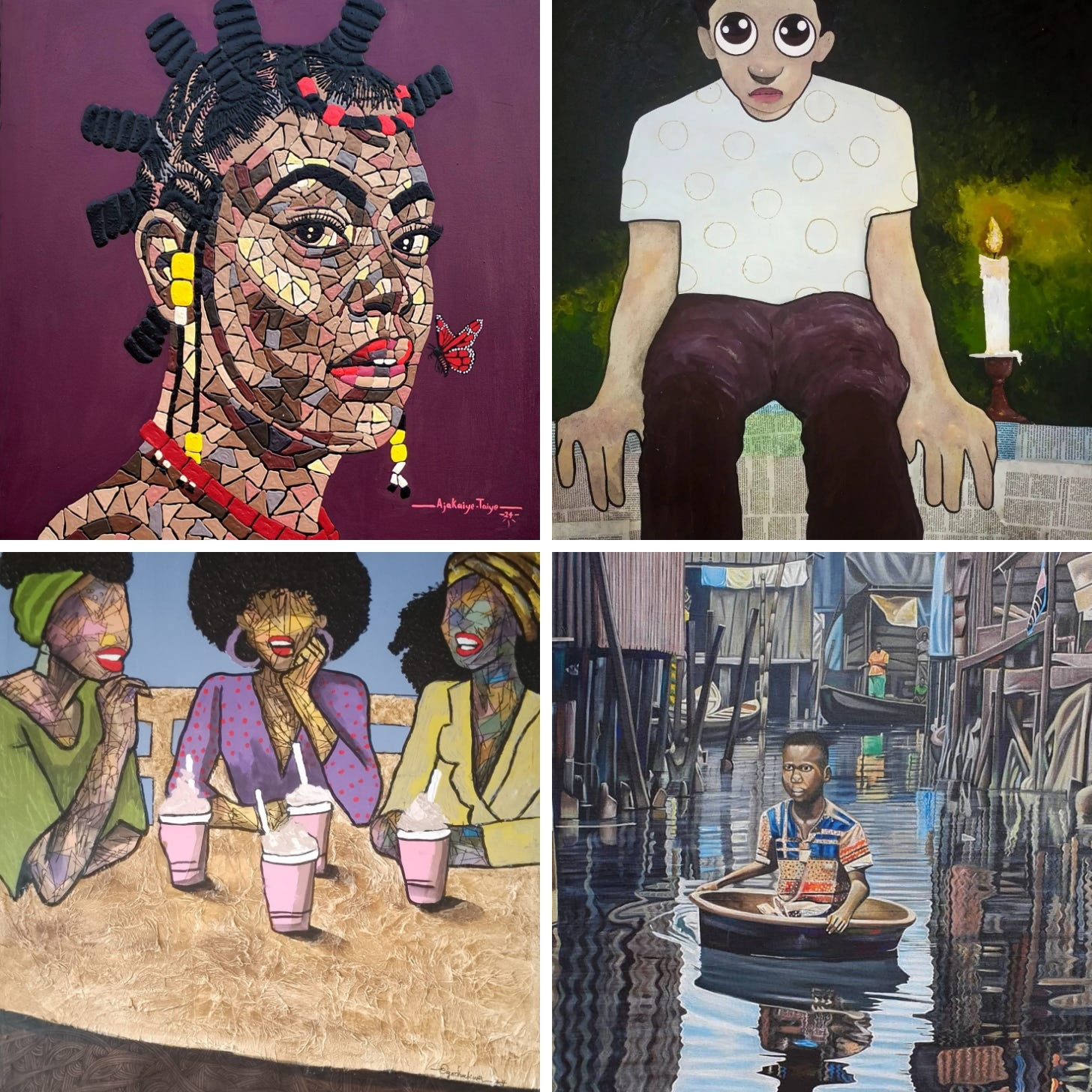
An Epitome of Beauty by Taiye Ajakaiye, 2024| Light in the Dark by Buchi Okeke, 2024| Gist With Us by Ogochukwu, 2024| Makoko Series 4 by John Adediran, 2024

💼 

"Kisses and Roses on Amazon To Open Offline Stores in Nigeria 

 Kisses and Roses eStore on Amazon will open offline stores in Nigeria to be located in the cities of Uyo and Lagos in 2025.

People can walk into the stores and order for the trending fashion, beauty and lifestyle products of different popular brands, including COVERGIRL, Chanel, D&G and Gucci distributed by Amazon and their orders will be delivered within a week in Nigeria.

Kisses and Roses will also cosponsor two beauty pageants in Uyo and Lagos for the promotion of Nigerian beauty, fashion and culture for the local and international entertainment industry.

PROMO CODES
Save 20% with promo code 2014QEVE | Amazon.com

Go shopping now!


Wednesday, November 6, 2024

New Still Life Art Photographs


The First Temptation

Focus on the Treasure

The Ballet of Romance

The Illusion of the Heavenly Sky

The Discovery of the Red Apple with the Golden Ring

The Foresight of Charles Darwin

Space Travel To An Unknown Planet 1

I See A Bright Future

Waiting for the Great Nollywood Director

Space Travel To An Unknown Planet 2

Everyone Counts in the World

Once Upon A Time There Was A Popular Smartphone

Focus on Your Future

Seize the Year

My Vision of Mecca 1

STOLEN PROPERTY 1

My Vision of Mecca 2

New Still Life Art Photographs by Ekenyerengozi Michael Chima for the Red Apple Series and Serendipity Series.

© Ekenyerengozi Michael Chima. 2024. All rights reserved. No copying, duplication and reproduction in any format of media without the authorization and permission of Ekenyerengozi Michael Chima and International Digital Post Network Limited.